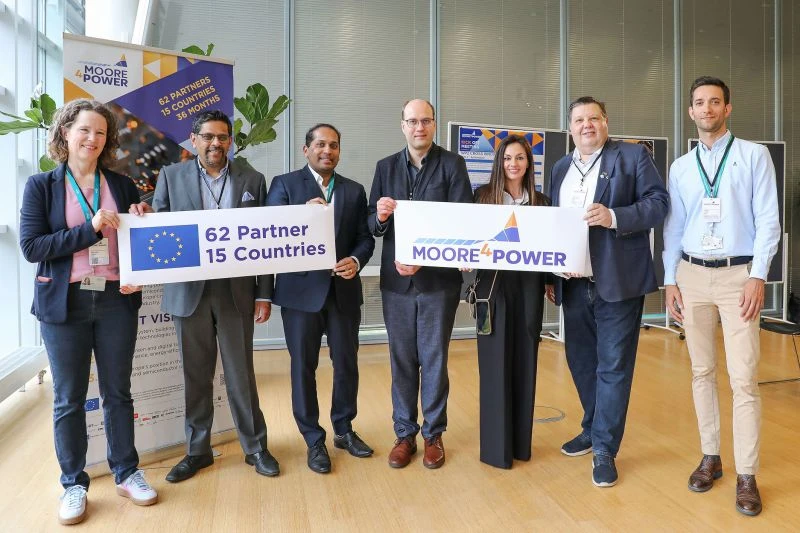
Prague, October 2026. i46 is a partner in Moore4Power, a three-year European research and innovation project coordinated by Infineon. The project started on 1 May 2026. It brings together 62 partners from 15 countries and has a total budget of EUR 91 million. It is funded under Horizon Europe through a call of the Chips Joint Undertaking, the European body that funds semiconductor research and innovation.
What is Moore4Power?
Power electronics convert and control electrical energy. They sit inside EV chargers, train propulsion systems and wind turbines. Moore4Power will combine silicon, silicon carbide and gallium nitride with sensing, control and communication functions, so that each technology is used where it performs best.
The project has concrete targets:
- E-mobility: charging systems, including bidirectional ones, will aim for efficiencies approaching 99 percent.
- Railways: the project will aim to cut propulsion losses by at least 30 percent.
- Development speed: AI-assisted engineering and digital twins will aim to shorten the time from first fab samples to a validated datasheet from several weeks to about one week.
- Lifecycle data: power modules will carry a Digital Product Passport to support maintenance, reuse and CO2 savings.
Trust and security in connected power electronics
Power electronics are increasingly connected. Researchers at Forescout found 46 new vulnerabilities in solar power systems from three vendors and linked such flaws to possible grid instability. The way a connected converter is updated and serviced is therefore part of its safety.
Regulation moves in the same direction. The EU Cyber Resilience Act requires manufacturers of connectable products to handle vulnerabilities throughout the product lifecycle, including by providing security updates. A manufacturer who ships security updates needs a way to prove that every update and every service session was authorised.
What i46 will do
i46 will lead one of the six cross-innovation demonstrators in the project's trust and security topic. Its title is strong authentication framework for offline devices. We will take it from TRL 4 to TRL 7, which means from "technology validated in lab" to "system prototype demonstration in operational environment".
Our work will cover four activities:
- Requirements: we will define what an authentication mechanism must provide when it is built into hardware devices.
- Secure access: we will develop a method for technician access and over-the-air (OTA) authorisation of updates for IoT devices.
- Quantum resistance: the method will be designed to remain secure against attacks by future quantum computers.
- Demonstration facility: we will build a facility where the system is shown on existing IoT devices, and where third parties can test the results remotely.
We will describe each activity in the coming months in separate articles.
Our aim
Our aim is to show that the update and service path of a connected power device can be authorised in a way that works with today's hardware and holds up against future quantum attacks.
What comes next
We will share progress on this blog and in our Cyber Resilience Act newsletter. We will also hold workshops with Czech academic partners, and we will present the results to potential customers in the final phase of the project. See the Moore4Power research card for the full project outline.
Funding acknowledgement: Moore4Power is funded by the European Union under Horizon Europe, call HORIZON-JU-CHIPS-2025-IA-two-stage of the Chips Joint Undertaking. Grant agreement ID: 101252572.
Disclaimer: the views and opinions expressed in this article are those of the author only. They do not necessarily reflect those of the European Commission or of the other Moore4Power partners, and neither can be held responsible for them.