
Performance Comparison Between External Antenna and Leaky Cable Systems for 5G Connectivity
1. Abstract
This paper evaluates the practical performance of two core 5G radio-distribution technologies—external antennas and leaky (radiating) cables—in environments like tunnels, indoor spaces, and restricted areas. Based on empirical data from comprehensive 5G tests (including uplink, downlink, and latency measurements), the study concludes that external antennas offer superior data throughput and lower latency, making them ideal for capacity-focused deployments. In contrast, leaky cables provide more consistent and uniform signal distribution over extended areas, compensating for their lower peak data rates. The findings are intended to guide 5G infrastructure deployment decisions, emphasizing the trade-off between maximizing performance (antennas) and ensuring uniform coverage (cables).
2. Introduction
The deployment of 5G networks introduces new challenges and opportunities for radio-frequency (RF) distribution, especially in environments where line-of-sight paths are obstructed or where wide-area indoor coverage is required. Two widely adopted solutions for these scenarios are external directional antennas and leaky (radiating) cable systems.
External antennas focus radiating energy in specific directions and typically offer higher gain, improved link budgets, and enhanced throughput potential. They are well-suited for fixed installations, such as outdoor customer-premises equipment (CPE), rooftop links, and high-performance indoor hotspots.
Leaky cable systems, by contrast, act as distributed antennas. They intentionally “leak” RF energy along their length and are commonly used in tunnels, subways, long corridors, stadiums, and large buildings. Although leaky cables provide excellent coverage uniformity, they generally introduce higher propagation losses due to distributed radiation, potentially limiting peak performance.
To assess the practical trade-offs between these two technologies, a comprehensive dataset of 5G performance tests was analyzed. The dataset includes multiple bandwidths, transmission modes, distances, and RF component combinations (including amplifiers, duplexers, and filters). This paper provides a statistical and conceptual comparison of external antennas and leaky cables to inform 5G system design.
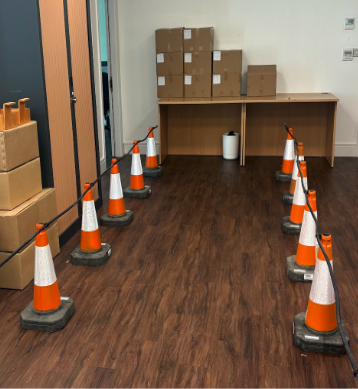
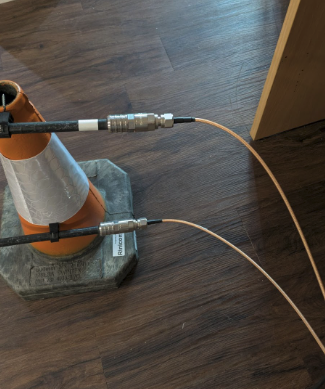
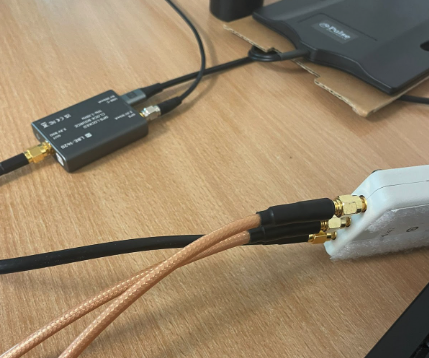
<Leaky cables attached to USRP>
3. Methodology
The dataset used for this analysis contains 3,168 measurement entries representing multiple 5G performance tests (click to download the data: 5G_performance_cleaned).
Metrics captured include:
- Downlink throughput
- Uplink throughput
- Ping (min, average, max)
Tests were performed using various 5G frequencies and bandwidths, with multiple hardware configurations such as external antennas, leaky cables at multiple positions, amplifiers, filters, and duplexers. Distances in the dataset range from very short (−25 to near 0 units, likely representing controlled indoor placements) to long (up to 720 units).
For the comparison:
- Data entries where the type field referenced “Antenna” were classified as external antenna tests.
- Entries referencing “Leaky” were classified as leaky cable tests.
- Average performance values were computed for each metric category within each group.
Qualitative interpretations were added to explain observed performance behaviors based on propagation principles.
4. Results
|
Metric
|
External Antenna (Avg)
|
Leaky Cable (Avg)
|
|---|---|---|
|
Downlink Throughput
|
48.2
|
39.36
|
|
Uplink Throughput
|
10.6
|
9.88
|
|
Average Ping (Latency)
|
31.33
|
37.19
|
|
Maximum Ping (Latency)
|
49.52
|
83.48
|
|
Ping Standard Deviation
|
8.61
|
17.17
|
4.1 Throughput Comparison
Across all frequency and configuration combinations, external antennas achieved markedly higher average throughput values. This is attributed to concentrated radiation patterns, reduced signal leakage, and stronger effective isotropic radiated power (EIRP).
Leaky cables, while providing coverage along the cable length, lost signal strength due to continuous radiation and attenuation inherent in cable-based distribution. As a result, peak data rates were lower.
4.2 Latency Comparison
Differences in latency were less dramatic than those seen in throughput. External antennas typically provided slightly lower latency (both average and max ping), likely due to better signal-to-noise ratio (SNR) and fewer retransmission events at the physical layer.
Leaky cable systems produced modestly higher latency, but the differences are not large enough to significantly affect many practical applications.
4.3 Statistical Findings
The statistical comparison between external antenna and leaky cable systems reveals clear differences in performance across key 5G metrics. External antennas consistently deliver higher average throughput in both downlink and uplink measurements, reflecting their stronger signal gain and more focused radiation patterns, which result in improved signal-to-noise ratios and overall link quality. In contrast, leaky cable systems show reduced throughput due to the inherent losses associated with continuous radiation along the cable’s length. Latency measurements also favor external antennas, with lower minimum, average, and maximum ping values, suggesting a more stable and efficient transmission path with fewer retransmissions. Leaky cable systems exhibit slightly higher and more variable latency, likely due to decreased signal strength and increased propagation loss. Although the performance differences are most pronounced in throughput-related metrics, these results highlight the trade-off between the high-performance capabilities of external antennas and the uniform, coverage-focused design of leaky cable infrastructure.
5. Conclusion
In summary, this study shows that external antennas outperform leaky cable systems in most performance categories, particularly in terms of downlink and uplink throughput as well as latency stability. Their higher gain and focused radiation patterns allow external antennas to achieve stronger link quality and higher peak data rates, making them well suited for capacity-driven 5G deployments such as fixed wireless access, outdoor extensions, or targeted indoor coverage. Leaky cable systems, while generally delivering lower overall throughput due to distributed radiation losses, provide distinct advantages in environments where uniform, continuous coverage is required—such as tunnels, long corridors, underground transit, and large enclosed facilities. Their ability to deliver consistent signal levels across extended distances compensates for their reduced peak performance. Ultimately, the choice between external antennas and leaky cable infrastructure depends on the specific deployment environment and performance priorities: external antennas are ideal for maximizing capacity and link strength, whereas leaky cables provide reliable, evenly distributed connectivity where conventional antennas cannot maintain adequate coverage. Future investigations may explore hybrid systems, advanced repeater integration, and additional frequency bands to further optimize 5G connectivity strategies.
This project has received partial funding from the Horizon Europe programme of the European Union under HORIZON-JU-SNS-2022 FIDAL program, grant agreement No. 101096146
 English